
What Is Jet Jewelry?
What is jet jewelry? It is jewellery carved from jet, an organic gemstone made of fossilized wood that polishes to a deep black lustre yet weighs almost nothing in the hand. Most antique jet jewellery found today was cut from Whitby jet, a material that formed over millions of years beneath the Yorkshire coast of England and became the signature of Victorian mourning. Artisans have shaped it into jet beads, brooches, pendants, and rings since prehistoric times, and people once wore a piece of jet to ward off evil or to honor the dead.
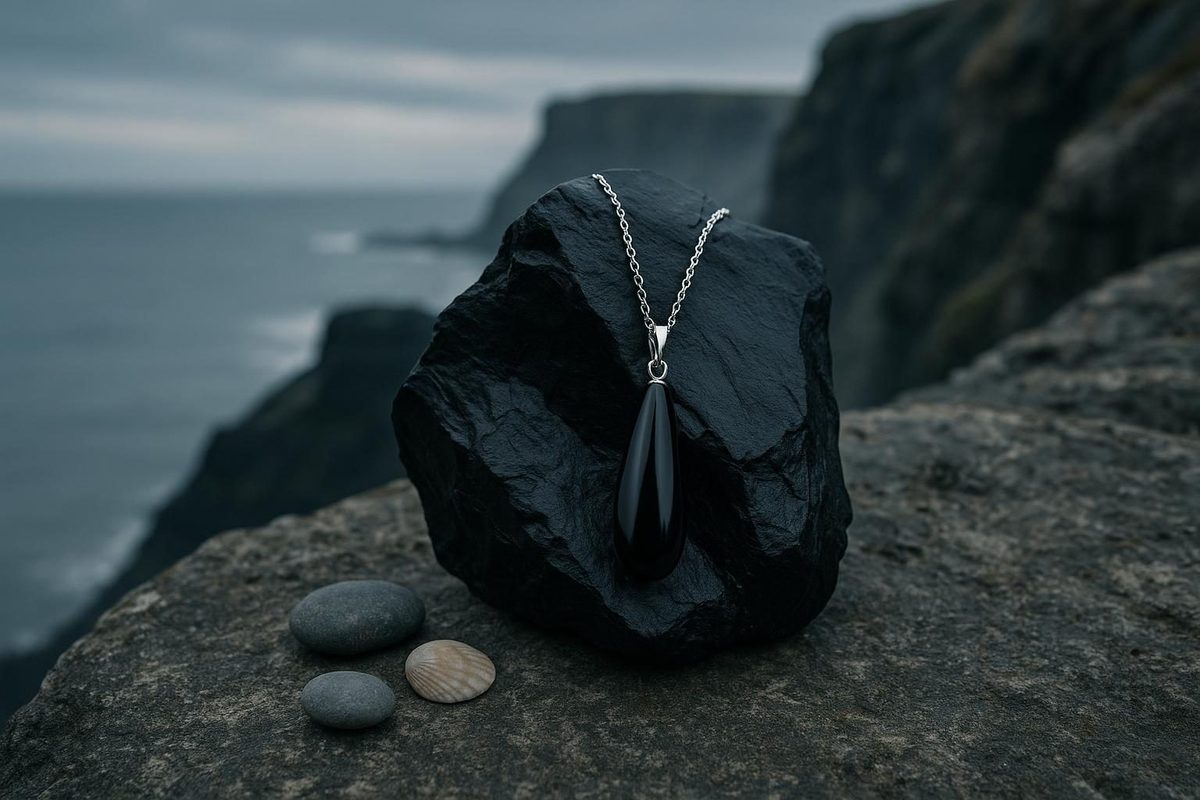
The Gemstone at a Glance
Jet is a gem-quality form of lignite, a low-rank coal, not a mineral. That explains how it behaves: warm to the touch, unusually light, soft enough to carve by hand, and easy to scratch.
| Property | Detail | Why it matters for jewellery |
|---|---|---|
| Material | Fossilized Araucariaceae wood | Organic, like amber and pearl |
| Age (Whitby) | About 180 million years | Finite supply |
| Hardness | 2.5 to 4 Mohs | Scratches easily |
| Streak | Brown on unglazed porcelain | Rules out glass |
| Weight | Far lighter than glass or onyx | Comfortable to wear |
| Best-known source | Whitby, North Yorkshire | The quality benchmark |
Where the Material Comes From
It began as trees related to today’s monkey puzzle (Araucaria) that were buried in sediment, cut off from oxygen, and slowly compressed. The Whitby seams sit in the Whitby Mudstone Formation of the Early Jurassic. How buried timber becomes gem-grade fossilized wood has its own guide; for buyers, two practical points matter more.
First, there are two types of jet. Hard jet is linked to saltwater deposits and takes a sharper, longer-lasting polish, so carvers prefer it. Soft jet is associated with fresh water and is prone to fine cracking, so a soft piece is more likely to show surface crazing a century later.
Second, Whitby is not the only source. Deposits also occur in Asturias in northern Spain, around Erzurum in Turkey (where it is called Oltu stone), in Poland and Germany, and in the American Southwest, where Pueblo and Navajo craftspeople worked what is now called Acoma jet in New Mexico. Collectors still rank Whitby material highest for its intense colour and fine grain. Mining there peaked in the 1800s; today most new material comes from beach finds after storms erode the Yorkshire cliffs, which keeps good supply scarce.
How to Identify Real Jet and Common Simulants
Genuine material feels warm and light, leaves a brown streak on unglazed ceramic, and gives off a coal-like smell when touched with a hot needle. Rubbed on wool, it also builds a static charge and lifts small scraps of paper, a trick amber and jet share. No single test settles it, so experienced collectors combine two or three.
| Simulant | What it is | How it gives itself away |
|---|---|---|
| French jet | Black glass | Cold, heavy, chips with a glassy shell-shaped fracture, no streak |
| Vulcanite (ebonite) | Hardened rubber | Fades to greenish-brown with age, smells of sulfur when warmed |
| Bog oak | Oak preserved in peat bogs | Browner tone, visible wood grain, duller polish |
| Plastic | Modern resin | Too glossy, mould seams, melts with a chemical smell |
The streak test has a blind spot that catches many beginners: bog oak and vulcanite also leave a brown line, so a brown streak only rules out glass and plastic. Pair it with weight and temperature, then try a heated needle on a hidden spot such as the back of a brooch. Glass won’t react, plastic melts, and true jet smells faintly of burning coal.
From Stone Age Beads to Victorian Mourning Jewelry
Prehistoric and Roman Britain
The oldest known worked piece is a small carving from Germany dated to around 10,000 BC. In Britain the gem was used from Neolithic times, and Early Bronze Age burials have produced elaborate necklaces of beads and spacer plates about 4,000 years old.
From the 3rd century AD, Yorkshire material went to Roman Eboracum (modern York), where archaeologists have found considerable evidence of production of rings, beads, and protective amulets.
Medieval Pilgrims and Spanish Azabache
In the Middle Ages, artisans cut crosses and rosary beads from it. Santiago de Compostela became a major centre for carved religious pieces and amulets, known in Spanish as azabache, sold to pilgrims on the Camino de Santiago. In Spain, the tradition of wearing a carved azabache charm as a protective talisman continues today.
Queen Victoria and the Mourning Fashion
The gem was already fashionable in the 1850s, but the death of Prince Albert in 1861 turned it into the uniform of grief. Queen Victoria wore mourning dress for the rest of her life, Whitby jet jewellery was part of it, and the court and then the middle classes followed her lead.
Etiquette expected sombre accessories for up to two years after a death. Artisans in the town of Whitby carved brooches, lockets, necklaces, and earrings, many decorated with urns, weeping willows, or a glazed compartment for the hair of the deceased. That is why so much antique work reads as mourning jewelry, even when nobody remembers who it mourned. The material also gave English the phrase “jet black” for the darkest possible black.
Boom and Bust in the Whitby Trade
At its peak in the early 1870s, the jet industry employed over 1,400 workers in roughly 200 Whitby workshops. Demand then fell away quickly. Mourning fashion relaxed, cheaper imports and glass imitations undercut prices, and by 1884 only about 300 people still worked in the trade.
What Does Jet Jewellery Look Like?
Pieces show a rich black colour and a smooth, glossy surface that never looks quite as cold as glass. Some Victorian vintage items combine the black gem with gold, seed pearls, or woven hair keepsakes. Common jewellery forms include:
- Brooches: oval or round, with floral carving or portrait cameos
- Necklaces: polished beads strung on silk cord, often graduated in size
- Jet rings: simple bands or small engraved plaques on metal shanks
- Pendants: oval or teardrop shapes with raised carved designs
- Earrings: drop styles, especially popular during the 1800s
Because the material is so light, even a large brooch or a long bead necklace stays comfortable all day, which onyx or obsidian of the same size would not.
How Artisans Turn Rough Material Into Jewellery
The stone is soft enough for hand tools but chips along thin edges, so one slip can ruin hours of work. Craftsmen start with rough pieces from the beach or from shale beds around Whitby.
- Selection: choose pieces free of cracks or soft spots, since hidden flaws open up during carving.
- Rough shaping: cut to approximate size with a fine-toothed saw.
- Detail carving: for cameos, remove the background by hand to raise the image.
- Lathe turning: round items such as beads are turned for symmetry.
- Polishing: work through finer abrasives, then oil and a soft cloth in stages, because the surface scratches easily.
Nineteenth-century workshops used treadle-powered machines to speed production, but most carving stayed manual. Techniques passed through apprenticeships, a tradition that a handful of workshops in Whitby maintain today.
How to Care for Antique and Modern Pieces
At 2.5 to 4 on the Mohs scale, the gem is softer than most minerals, so care is mostly about preventing scratches and sudden temperature changes.
- Store pieces separately in soft cloth pouches, away from harder materials like diamond or chalcedony.
- Clean with a damp, soft cloth and dry immediately. Never use ultrasonic cleaners or chemical solutions.
- Keep it away from direct sunlight and heat, which can cause drying and cracking.
- Apply a thin layer of mineral oil once or twice a year to maintain the lustre.
Antique pieces need extra caution. Age can make the material more brittle, especially around thin carved details and where a pin or hinge meets the stone. If crumbling starts, stop wearing the piece and consult a specialist conservator.
What Is Jet Jewelry Worth Today?
Simple beads sell for $20 to $50 each, while an elaborate carved cameo brooch from the 1860s can fetch $500 to $2,000 or more. Four things drive value: whether the material is genuine, the quality of the carving, condition, and documented provenance.
If you are hunting for antique jewellery or comparing modern pieces for sale, the same quality markers apply: uniform colour, a smooth warm feel, light weight for the size, and crisp carving. A “Victorian” brooch that feels cold and heavy is almost certainly glass, which sells for far less than carved Whitby work.
Where to Start If You Are New to It
Modern jewelry designers still carve the gem by hand, making contemporary pieces in unisex and women’s jewellery.
The quickest way to understand what is jet jewelry is to hold a verified Whitby piece at a museum or a reputable dealer. Then compare its weight and warmth against glass and plastic; the difference shows within seconds. If an unknown piece passes, a streak test on a hidden spot and provenance paperwork settle the rest; the jet jewelry guides here cover styles and buying.
Frequently Asked Questions About Jet Jewelry
How can you tell if jewelry is jet?
Real specimens feel warm and light compared with glass or onyx, leave a brown streak on unglazed ceramic, and smell faintly of coal under a hot needle. Bog oak and vulcanite also streak brown, so combine at least two tests.
Is this gemstone worth anything?
Yes. Values range from $20 for simple beads to over $2,000 for elaborate carved pieces from the Victorian era. Raw Whitby specimens sell for $5 to $30 per ounce depending on quality. Antique jewellery with documented provenance commands the highest prices.
What is jet jewelry made from?
It comes from fossilized wood, specifically ancient conifer trees buried under sediment during the Jurassic period. Pressure and heat transformed the wood into a polishable black substance classified as lignite coal.
Is it the same as onyx?
No. Onyx is a banded variety of chalcedony, a mineral. This substance is organic, formed from fossilized wood. Onyx feels cold, glassy, and heavy, while the fossilized variety feels warm, light, and slightly waxy.
What is French jet?
It is a simulant made from black glass, not fossilized material. It was produced as a cheaper, mass-market alternative to genuine Whitby specimens. It looks similar but feels noticeably heavier and colder, and it chips with a glassy, shell-shaped fracture.