
What Is Jet Jewelry Made Of?
What is jet jewelry made of? Jet, the black organic gemstone behind Victorian mourning brooches, is fossilized wood: a compact form of lignite that began as trees related to the modern monkey puzzle (Araucaria), which sank into stagnant water roughly 180 million years ago. It isn’t a mineral or a crystal. Oxygen-starved decay and the weight of sediment turned the timber into a carbon-rich solid light enough to wear in large pieces and soft enough to carve by hand.
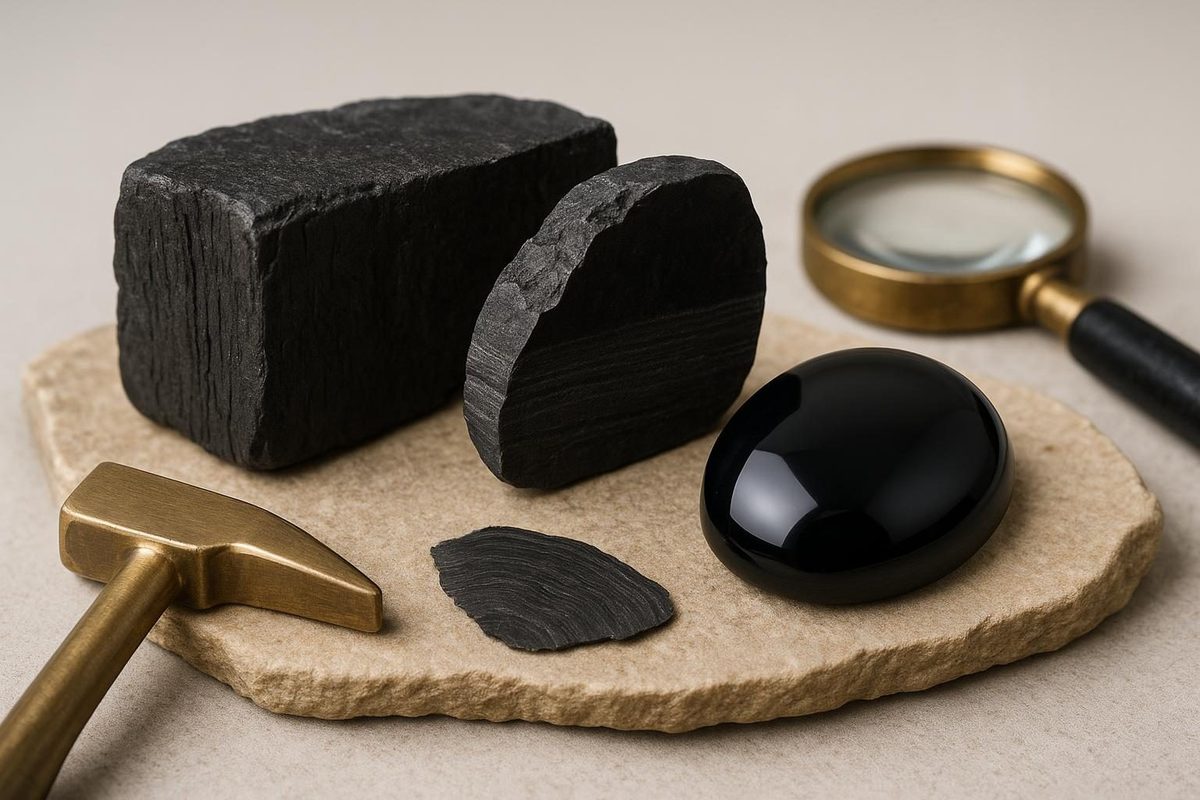
What Is Jet Jewelry Made Of? Lignite From Ancient Trees
Gemologists group jet with amber, pearl, and coral as organic gems, because a living organism produced it. Geologically it sits on the coal ladder: most references call it lignite, the lowest rank of coal, while Encyclopaedia Britannica describes it as a dense, compact variety of subbituminous coal, one rung higher. The difference from ordinary coal is texture. Coal is brittle and splits along its layers, while gem-quality material is tough enough to turn on a lathe and polish to a bright finish.
| Property | Measurement | What it tells you |
|---|---|---|
| Hardness | 2.5 to 4 on the Mohs scale | Scratches easily |
| Specific gravity | 1.30 to 1.34 | Light enough for large brooches |
| Streak | Brown on unglazed porcelain | Rules out glass and onyx |
| Static | Builds a charge when rubbed, like amber | Plastics do this too |
How Buried Wood Became a Gem Over Millions of Years
It started as driftwood. Trees washed into Jurassic seas and swamps, became waterlogged, and sank into fine mud. Buried without oxygen, the wood could not rot normally. Bacteria broke down part of it, and the growing weight of sediment compressed the rest into flattened planks and lenses. At Whitby the source layer is the Jet Rock, part of the Whitby Mudstone Formation, laid down about 181 million years ago.
Two grades came out of that process. Hard jet probably formed in seawater; it is tougher, takes a finer polish, and survives detailed carving. Soft jet probably formed in fresh water and is more fragile once worked. Both share the same deep black or dark brown color.
Where the Raw Material Is Found Today
Whitby and the Yorkshire Coast
The North Yorkshire coast produces the most prized material, collected from eroding cliffs and beaches or mined. In 1873 about 1,500 people worked in the trade, supplied by roughly 200 miners, according to the Whitby Museum, and workshops around Whitby carved thousands of vintage pieces and Victorian necklaces for buyers across Europe.
Asturias and Galicia: The Azabache Tradition
Spanish jet, called azabache, comes mainly from Asturias and is younger than the Yorkshire material. Spanish carvers turned it into crosses, scallop shells, and the fist-shaped higa charm, which pilgrims on the Camino de Santiago bought as symbols of faith. Small workshops in Asturias and Galicia still carry on the tradition.
Turkey, Poland, Germany, and the American West
Smaller deposits occur near Erzurum in Turkey (sold locally as oltu stone), in Poland and Germany, and in Utah, Colorado, and New Mexico, where Navajo and Pueblo artisans used it. The oldest worked piece known, a carving from about 10,000 BC, was found in Germany. None of these sources matches Whitby’s reputation for consistent hardness and density.
Real Jet or an Imitation? Five Lookalikes and What They Are Made Of
Each common lookalike copies the color, but none copies the mix of warmth, low weight, and brown streak.
| Lookalike | Made of | How to spot it |
|---|---|---|
| French jet | Black glass, often faceted | Cold, heavy, glassy reflections |
| Vulcanite (ebonite) | Rubber hardened with sulfur | Fades to khaki in sunlight, sulfur smell when warmed |
| Bog oak | Oak preserved in peat bogs | Brownish tone, visible grain |
| Plastic | Synthetic resin | Mould seams, rounded edges |
| Onyx | Chalcedony, usually dyed black | Cold, heavy, much harder |
A brown streak on unglazed porcelain rules out glass, plastic, and onyx, which makes the streak test a quick first screen against common imitations. The reason it fools people is that ebonite, bog oak, and ordinary brown coal leave a brown streak too, so a brown line proves the piece is organic or rubber, not that it is genuine jet.
Checking a Piece Without Damaging It
We recommend this order, harmless checks first:
- Hold it. The genuine material warms quickly to skin temperature; glass and onyx stay cool.
- Weigh it in your palm. A large carved brooch feels surprisingly light.
- Check the edges under a loupe. Hand carving leaves crisp edges; moulded glass, rubber, and plastic show rounded edges and seam lines.
- Look for khaki fading on raised areas, a sign of old vulcanite.
- Streak test a hidden spot only, such as the back of a bead, because it removes a little material.
Skip the hot needle test. A heated pin does make jet smell like burning coal, but the Whitby Museum warns against it because it permanently damages the surface.
Why Queen Victoria Made Whitby Jet Fashionable
Bronze Age Britons strung it into necklace beads, and Roman workshops at York carved it into pendants and amulets from the 3rd century. The real boom came after Prince Albert died in 1861. The queen wore jet as part of her mourning dress for years, and British mourning customs called for black accessories. The material was black, warm, and light enough for large necklaces, brooches, earrings, and lockets carved with symbols of remembrance, which is why so much Victorian era mourning jewelry survives.
Caring for a Soft, Organic Gem
Soft fossil wood scratches against harder stones and can crack from a sudden temperature change or a drop onto tile.
- Store each piece wrapped in tissue or soft cloth, apart from harder items.
- Keep perfume, hairspray, and household cleaners off it.
- Clean surface dirt with mild detergent and warm water on a moistened cotton swab, as the Whitby Museum suggests, and never leave it soaking or near heat.
- Once dry, restore the shine with a gentle wipe of baby oil, the museum’s own advice.
- Avoid ultrasonic and steam cleaners, which the International Gem Society also warns against.
So, what is jet jewelry made of? Fossilized Araucaria wood turned into compact, carbon-rich lignite, which explains its warmth, its low weight, and its softness. Start by running any piece you own through the five checks above. If it passes, compare the carving with genuine pieces currently for sale, or browse women’s jewelry styles for modern designs.
Questions Buyers Ask Before Paying for a Piece
Is jet a precious stone?
No. It is an organic gemstone, usually called semi-precious; the traditional precious stones are diamond, ruby, sapphire, and emerald. Fine carved Whitby pieces can still command good prices at auction because of their age and craftsmanship.
What’s the difference between onyx and jet?
Onyx is a banded variety of chalcedony, a hard mineral rating 6.5 to 7 on the Mohs scale, and black onyx in jewelry is usually dyed. It feels cold and heavy and won’t leave a brown streak on porcelain. Jet is warmer, far lighter, and much softer.
Is jet the same as petrified wood?
No. Petrified wood forms when minerals replace the wood’s cell structure, turning it to stone. Here the wood was never mineralized; it was compressed and chemically altered without oxygen, so it keeps its carbon-based organic composition.
Is jet jewellery worth anything?
Yes, depending on age, origin, craftsmanship, and condition. Simple Victorian beads might sell for $20 to $50, while finely carved Whitby brooches or mourning lockets from the 1860s can fetch $200 to $2,000 or more. The International Gem Society notes that the material has declined in popularity in modern times.